Compound profile · 5 min read
What Is GHK-Cu? The Copper Peptide Explained for Researchers
GHK-Cu is the copper(II) complex of the tripeptide Gly-His-Lys. Its structure, why the powder is blue, molecular data, how it is characterized on a COA and how to store it.
GHK-Cu is one of the smallest and best-characterized peptides on the research market. It is a three-amino-acid sequence, glycyl-L-histidyl-L-lysine, bound to a copper(II) ion. This page covers what the molecule is and how to check the material you receive.
Where GHK comes from
The tripeptide GHK was first described in 1973 by Loren Pickart, who isolated it from human plasma. It was soon recognized for its very high affinity for copper(II), and most of the later literature studies it as the copper complex. Because the structure is simple and the metal binding is well characterized, GHK-Cu is widely used as a reference compound in metal-peptide chemistry.
Molecular data
| Sequence | Gly-His-Lys · Cu(II) |
|---|---|
| CAS number | 89030-95-5 |
| Molecular formula | C14H24CuN6O4 |
| Molecular weight | 403.9 g/mol (GHK alone: 340.4 g/mol) |
| Appearance | Blue to blue-violet lyophilized powder |
Why the powder is blue
The color comes from the copper(II) ion. Copper is coordinated by nitrogen atoms from the glycine amine, the histidine imidazole ring and the peptide backbone, and that coordination absorbs light in the red part of the spectrum. A pale or white powder sold as GHK-Cu is worth questioning: it may be the free peptide, or have low copper content.
What to look for on the COA
- HPLC purity of the peptide component, with the chromatogram.
- Mass-spec identity showing GHK (about 341 m/z for [M+H]+) or the copper complex.
- Copper content or ratio, where reported, confirming the complex rather than free peptide.
- A lot number that matches the vial.
Our general guide to reading a peptide COA explains each field.
Storage and handling
Store sealed vials at -20 °C long term or 2–8 °C short term, protected from light. Copper complexes can be sensitive to strong reducing agents and chelators, so keep that in mind when choosing buffers. See the storage guide for more.
GHK-Cu at Atlas
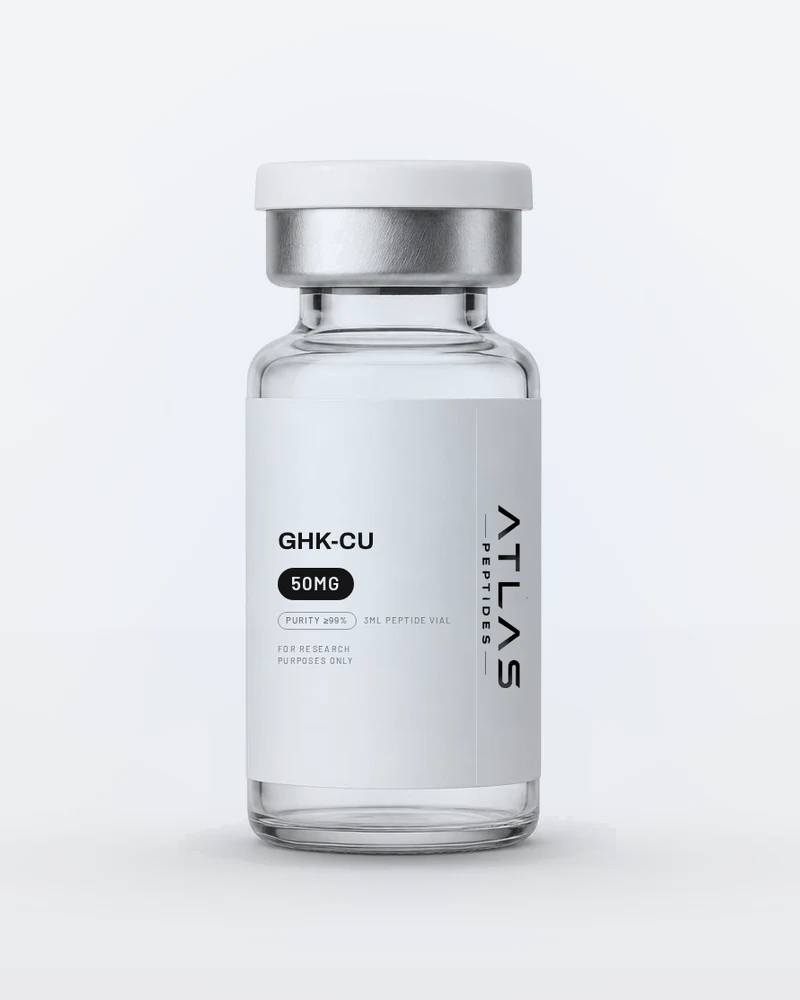
Atlas GHK-Cu is supplied in 50 mg and 100 mg vials with a lot-specific independent COA. It is also a component of our multi-compound blends. For laboratory research use only.
Compounds in this guide
Keep reading
- Where to Buy Research Peptides Online: A 7-Point Supplier Checklist
- BPC-157 vs TB-500: How the Two Research Peptides Differ
- Peptide Blends: How to Read a Multi-Peptide COA
Research use only. For Research Use Only. Not for human or veterinary use. Not for diagnostic or therapeutic use. Not a drug, food, cosmetic or dietary supplement. Not for resale to consumers.